
Interviews with Artists
Marine One
-
Interview by Nastia Svarevska
-
Published in December 2025
-
Confronting Marine One’s work is a peculiar pleasure: part delight, part disquiet, part recognition, part estrangement. Soft fabrics beg to be touched, absurd juxtapositions make you stop, and subtle shifts in perception reveal how identity and cultural codes quietly shape the body — often without us noticing.
It is in this liminal space — where the comic collides with the uncanny, and the intimate rubs against the public — that our conversation begins. I asked Marine to reflect on her journey into art-making, the evolution of her practice, and the ways humour, audience interaction, and memory operate as frameworks that are simultaneously playful, perceptual and provocatively subversive.
-
Could you introduce yourself and tell me a little about your background and how you first came into art-making?
I grew up drawing a lot, mainly influenced by my dad, who collected manga. I read all kinds of manga from a young age — even some I probably shouldn’t have. I would draw during school breaks, but the only formal art I did in high school was painting classes. I didn’t really think seriously about fine art until I went to art university in Italy. I knew I wanted to do something creative, and I chose Italy partly because tuition was cheap. Fine art felt like the most suitable medium to express what I wanted to make. That’s how it started.
And what informed your decision to come to the UK?
I did my BA in Italy, but I realised the MA there wouldn’t be very different from the BA. I had also been to London before and really liked the galleries, and some friends recommended it. So that’s why I decided to move here.
Do you feel you could have pursued the same path if you’d stayed in Japan?
Honestly, probably not. Art institutions in Japan are very different from those in Europe. To get into a top art university, you need to pass very specific exams and demonstrate highly structured, technical skills. While students are very skilled, the system is quite rigid — it tends to put you in a box. I think if I’d stayed, I wouldn’t have been able to make the free-form work I do now.
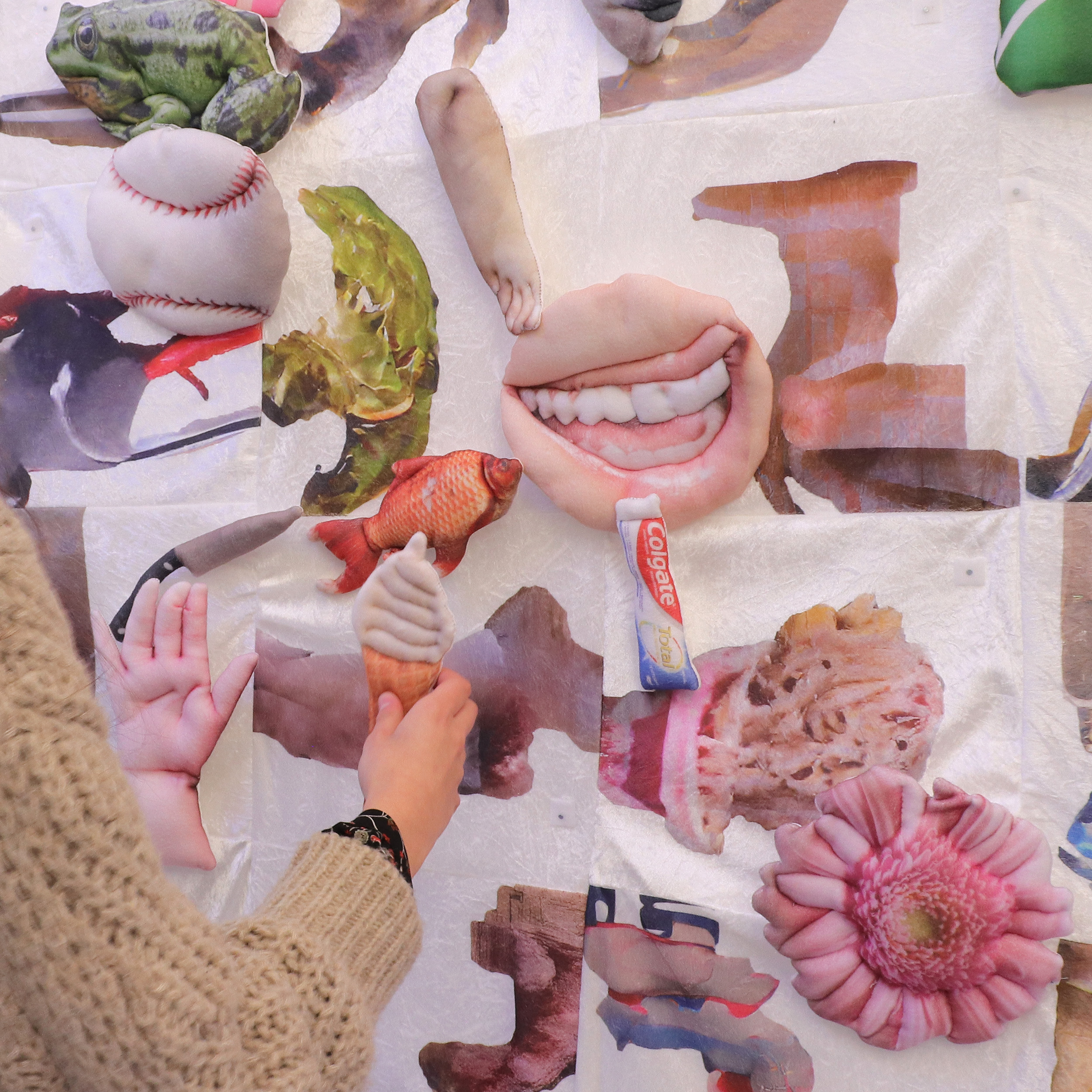
Tactile Mundanity, 2022, interactive installation, velcro, Thread,Bag, and Toy stuffing
It sounds like you wanted to break away from the rigidity of the academy. Would you say that’s connected to the “playful unease” in your work — the humour and tension you use to hold the viewer’s attention?
Maybe. I left Japan when I was 15, mostly because my mum wanted me to study English abroad. I wasn’t consciously thinking about art at that age, but being in a new environment allowed me to be open-minded. I’ve always been attracted to things that are slightly off, visually or conceptually — unsettling but also funny. Even in high school, I explored that. I’d draw someone holding a spoon with a whole chicken standing on it, for example. Humour acts as a cushion in my work: pieces that look a little scary or uncomfortable gain a levity that eases the tension. Sometimes the unease and humour emerge simultaneously; it’s not calculated — it just happens.
That seems central to your creative process. How do you develop your ideas?
Usually, I start with the final visual in mind. For installations, I imagine the end result first, then think about materials, themes, and details. The image exists in my head before I start, and I bring it together with whatever I’ve wanted to make in the past.
Speaking of materials, your use of fabric is notable. How do you think softness functions in your practice?
I began using fabric in interactive installations, thinking about how audiences engage tactilely with the work. Studying at Central Saint Martins (University of the Arts London) helped — there were workshops and technicians who knew a lot about fabrics. I enjoy working with them, and the softness can ease tension. When the subject matter is serious or heavy, soft materials prevent the work from feeling too dark and make it approachable. People want to touch and engage, which adds another layer to the experience.
So the audience is central to your work?
Definitely. Even in non-interactive work, I consider the relationship between the work and the audience. The work leaves an impression in the viewer’s mind — it’s a reciprocal experience. For example, an apple sculpture might make someone think of Adam and Eve, or a banana might trigger a cultural reference. The work and the viewer are in constant dialogue; it’s never one-way.
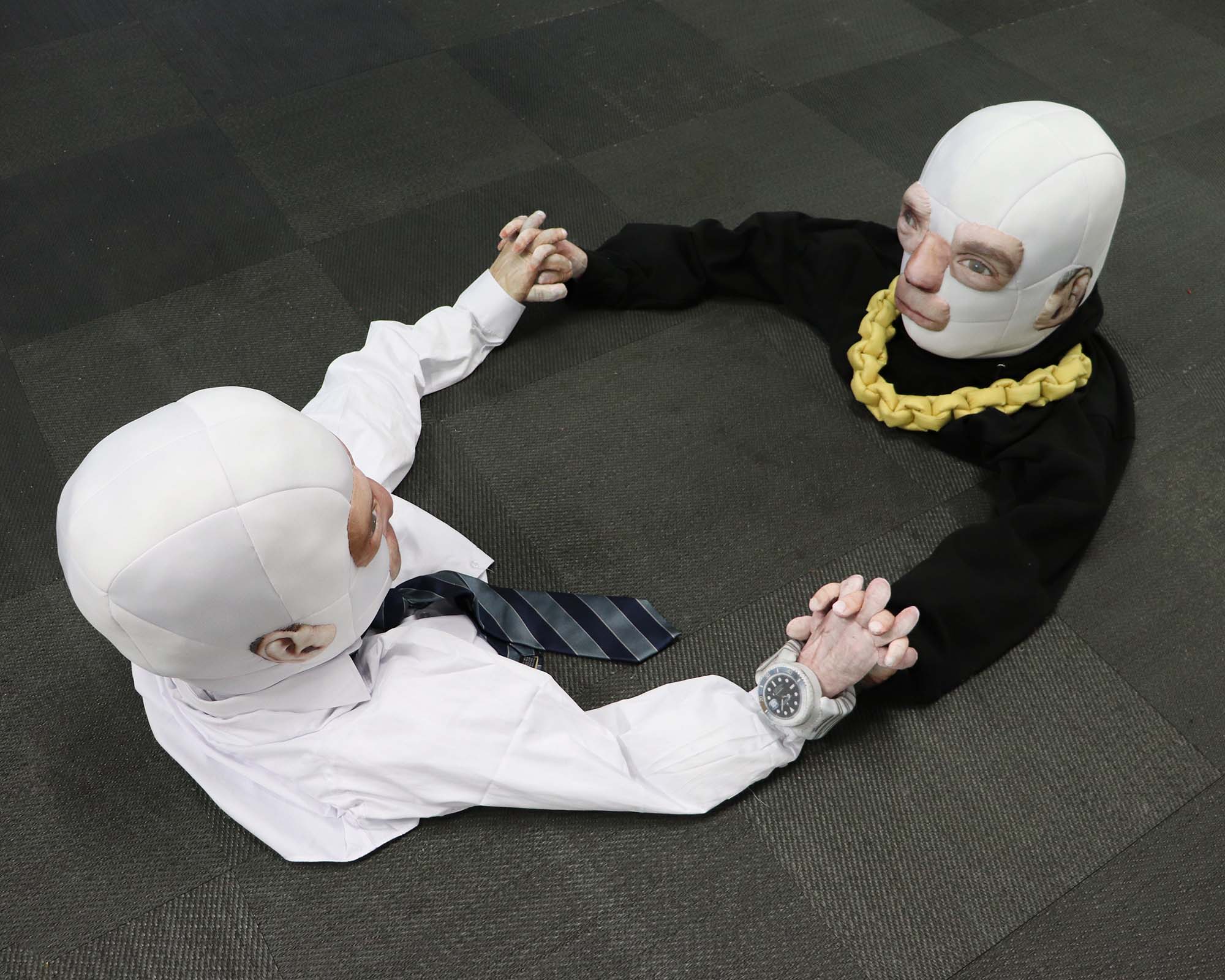
Untitled (Nicolas and Ryan), 2023, installation, fabric, foam sponge, thread, toy stuffing, shirts, hoodies and tie, 150 x 110 x 45cm

Untitled (Conner), 2022, interactive installation, table, chair, fabric, foam sponge, thread, toy stuffing, cellphone handset, wire, paper napkin, plastic and glass
That seems to connect with the hybrid creatures in your Untitled series. Do you see those works as encouraging this reciprocal gaze?
Yes, partly. I like combining unexpected things to glitch the viewer’s expectations. Seeing odd pairings — like a soft velvet fish — can surprise people and make them stop and think. It’s funny, but it also leaves an impression. I want the audience to notice the incongruity, and through that, to engage with the work more deeply.
You’ve described toxic masculinity as a “shared illness” that manifests differently across cultures. Does the series engage with toxic masculinity or objectification?
Not exclusively. I’m interested in masculine figures that I rarely see in art. I wanted to explore them in a neutral, object-like way. It grew from my engagement with feminist art practices, but I didn’t feel the need to focus on female bodies. Approaching masculinity this way became a way to stretch the series conceptually. Toxic masculinity harms everyone. I experienced it strongly in Japan, where misogyny is deeply embedded. There’s significant hostility toward feminism, reinforced by rigid expectations of masculinity. Unlike Western “macho” ideals, Japanese masculinity emphasises tireless work and strict gender roles from childhood. Even children’s books and magazines separate content strongly by gender — pastel colors for girls, black and vivid colors for boys.
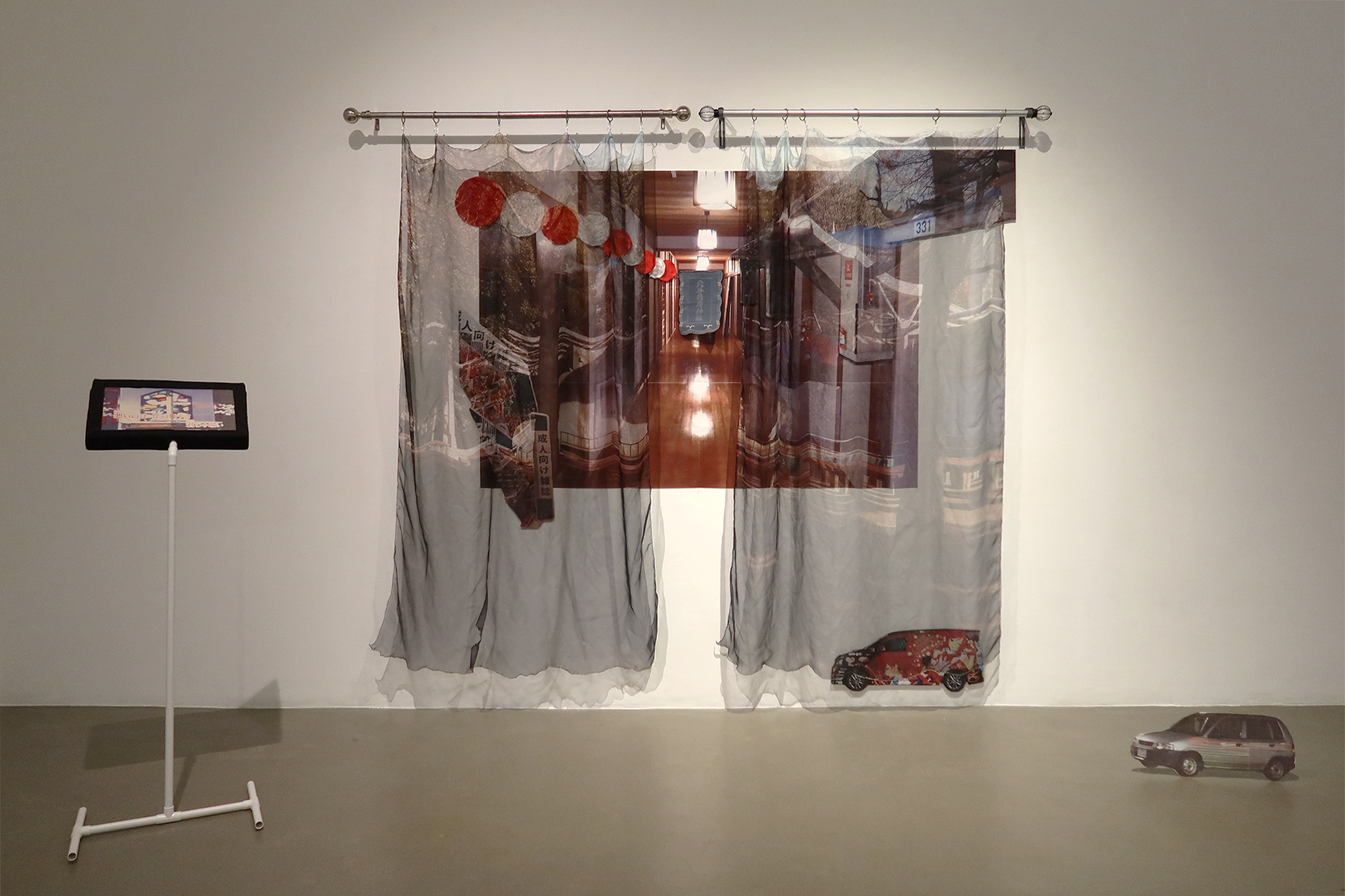 IMG_1895, 2025, installation, paper, canvas, fabric, thread, curtain rod, foam sponge, cardboard and pipe, 320 x 250 x 100cm
 You often draw from both public image banks and family archives. What happens when personal memory becomes entangled with collective imagery?
I like to create contrasts. Pairing a personal photo with a neutral, almost clinical internet image highlights differences. Neutral images act as tasteless, objective elements, while personal photos carry memory. The tension between them produces humour, unease, and a sense of duality.
Which is what you did in the work that you showed at Pickled! exhibition, IMG_1895. There was a sense of entering memory without fully inhabiting it.
Exactly. The curtain invited viewers into a perspective, like a corridor, but it was flat — there was nowhere to go. It creates an invitation into memory without offering full access.
I like this duality of recognition and distance. Does this process help you reflect on your own memories?
Yes. Using my own photos — like from New Zealand 15 years ago — allowed me to reflect on memories I didn’t enjoy at the time. The process felt almost like a funeral for those memories, or a way to celebrate and let them go. It helped me store them somewhere tidy.
And inviting the viewer turns that personal reflection into a shared celebration.
Exactly. I enjoy having the audience participate in processing memories alongside me.
I’m thinking of the work in the window where you changed the position of the figure multiple times, Untitled (Jake). That also seems to engage with memory and the passage of time.
Yes, that was interesting. The piece was on a busy road, so commuters would notice it in passing. The figure remained in one position for a week, then I’d change it. Even glimpsed peripherally, the subtle shifts became part of viewers’ daily rhythm. I enjoyed the idea of small shifts impacting perception of everyday life.
That lingering presence seems important in your work. How do you think about the “afterlife” of a piece?
I like the idea of a work lingering in someone’s mind. It could be something they enjoyed, disliked, or had strong feelings about. It comes back over time, and the reflection can change. That unpredictability is what I enjoy — I want the work to be memorable in a way that continues after the immediate viewing. It lives a life of its own, even after someone has left the space. Even if they hate it, it’s still part of their memory — that’s a beautiful aspect of art.
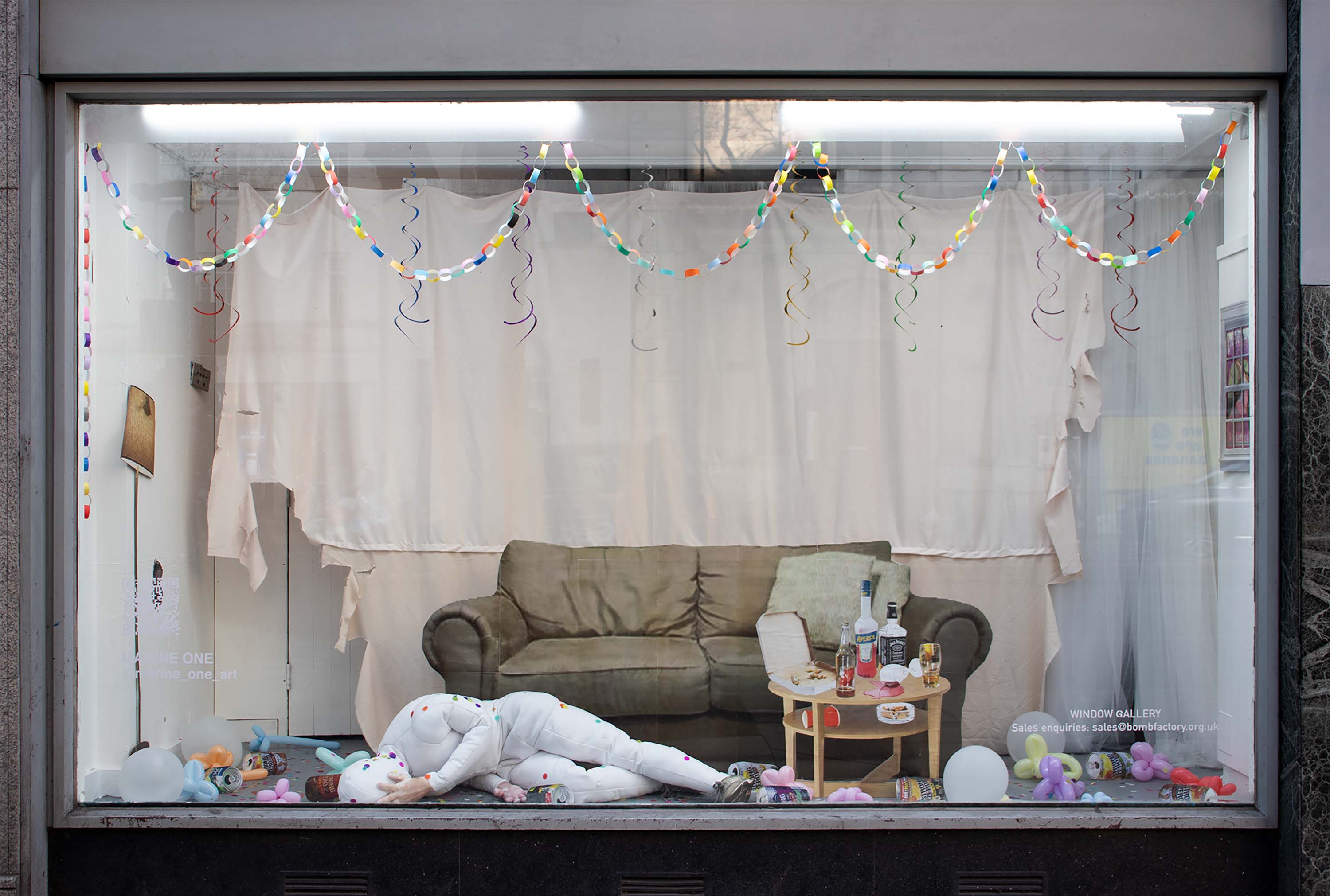
Untitled (Jake), 2025, installation, Paper, fabric, toy stuffing, balloon, and cardboard, 390 x 220 x 120cm
-
Marine One (b. 1997, Tokyo) is a London-based visual artist who works in a range of media, including installation, painting, sculpture, video and textiles.
-
︎ @marine_one_art
marineone.info
-
If you like this why not read our interview with Fabrizio Previti.
-
© YAC | Young Artists in Conversation ALL RIGHTS RESERVED